
Australia’s home of Weld-On products
Storage Temperature Reference Chart
Store solvent cements and primers within the temperature range indicated in the table above. If stored outside, store in the shade within this temperature range. Keep away from heat, spark, open flame and other sources of ignition. Keep container closed when not in use. If the unopened container is subjected to freezing, it may become extremely thick or jelled. This cement can be placed in a warm area, where after a period of time, it will return to its original, usable condition.
Cement Type | Storage Temperature |
|---|---|
PVC | 40°F (5°C) – 110°F (43°C) |
CPVC | 40°F (5°C) – 90°F (32°C) |
ABS | 40°F (5°C) – 110°F (43°C) |
Primer | 40°F (5°C) – 110°F (43°C) |
Specialty Cements | 40°F (5°C) – 110°F (43°C) |
Multipurpose Cements | 40°F (5°C) – 90°F (32°C) |
Calculator
Instructions
Enter the quantity of fittings per configuration and pipe diameter in the appropriate blue box in the chart to the right.
To reset values, simply highlight over the desired cells and press the “Delete” button on your keyboard. Putting in “0” (zero) as a value also functions as a blank cell.
The results in the yellow boxes are an estimation of how many gallons, quarts, or pints you will need for the job at hand.
Note: Use the cement/primer calculator for each cement separately.
Example: I am using Weld-On 705 for my 6″ and smaller diameter pipe and Weld-On 717 for my 8″ thru 12″ pipe.
The first step is to populate the appropriate cells for the 6″ and smaller sizes. Once the total amount of cement/primer has been recorded then delete all the cells back to blank and re-populate them with the 8″ thru 12″ sizes.
Safety
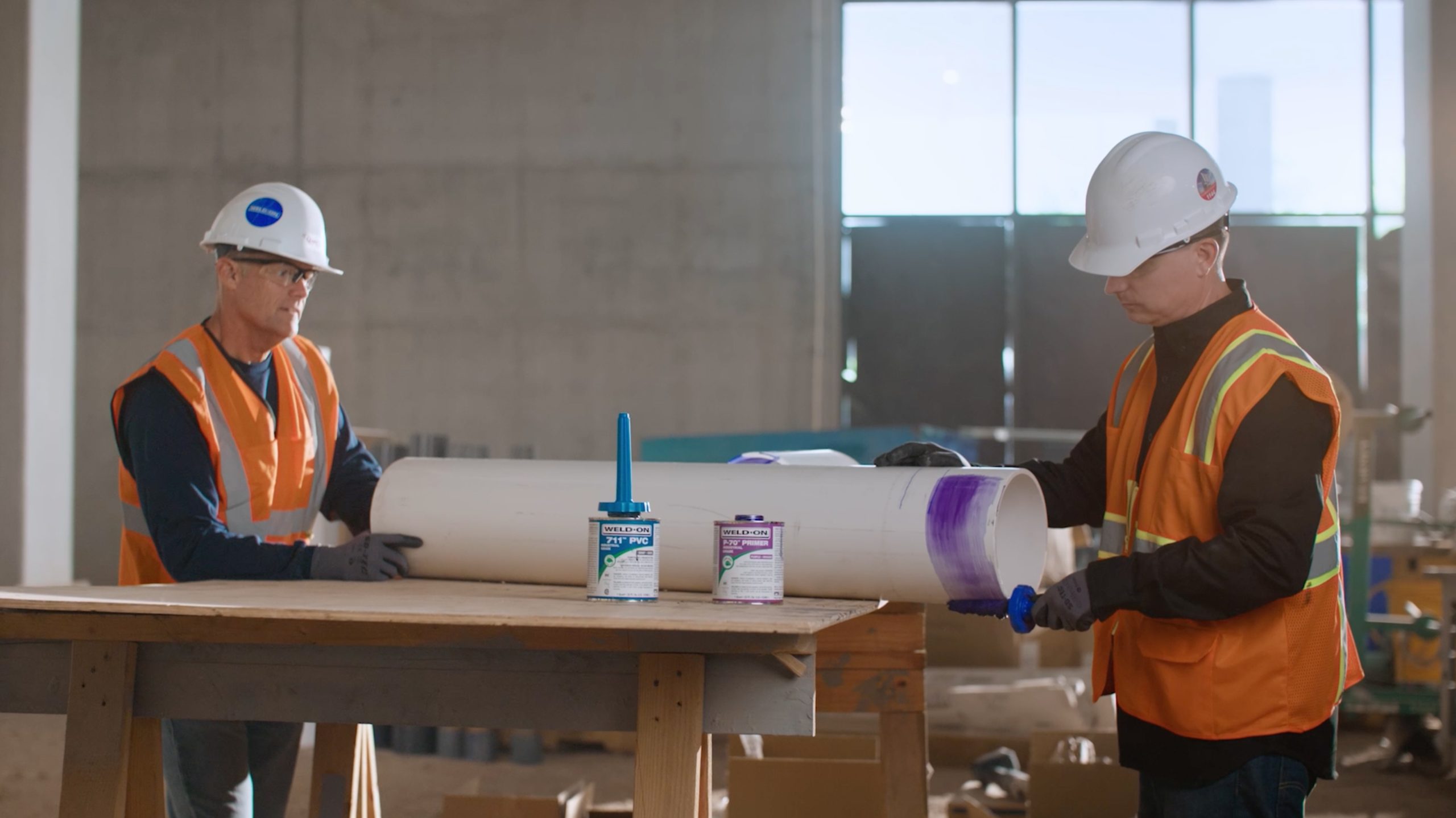
All Weld-On solvents cements and primers can successfully be used to solvent weld plastic piping systems when correct application and safety procedures are followed. Always read directions on our product labels and following these safety guidelines.
- Do not use or store Weld-On products near sparks, heat, flame or other sources of ignition. Ensure that all equipment in the work area is electrically grounded to prevent sparks.
- Do not smoke, eat, or drink when using Weld-On products. Ensure that the work area is well ventilated and avoid breathing the solvent vapors.
- Wear NIOSH approved respirators when solvent welding piping systems in enclosed areas, or any area with inadequate ventilation.
- Wear proper protective equipment (safety glasses and gloves).
NOTE: PVC and CPVC piping systems should not be used, or tested, with compressed air or gases. Compressed air or gas may contain stored energy that can result in catastrophic failure (including bodily injury, death, and/or property damage) if the piping system is breached. Use hydrostatic (water) pressure test only.
CAUTION: If Weld-On solvent cements and primer are used to install potable water piping system, do not use dry granular calcium hypochlorite, a water treatment chemical, to disinfect the piping system. Mixing the two may cause a volatile chemical reaction. Instead, use non-volatile chlorinated water to purify the piping system.